
Protecting Your Premature Baby from RSV: A WA Parent's Guide
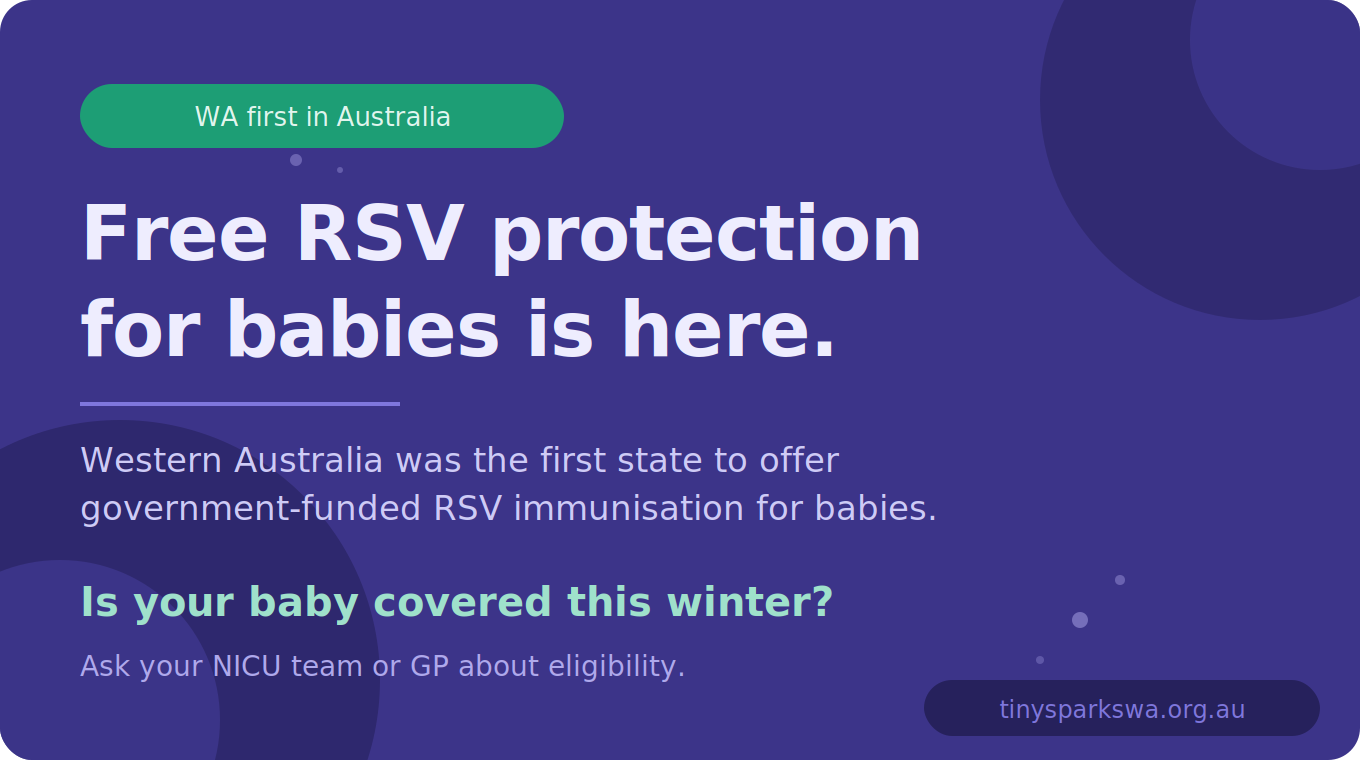
If your baby has spent time in the NICU, you've probably heard the nurses and doctors mention RSV, often with a serious tone. That's because respiratory syncytial virus (RSV) is one of the most significant health risks your baby will face after leaving hospital, particularly in their first winter home.
The good news is that Western Australia is leading the country when it comes to protecting vulnerable babies from RSV. Here's what you need to know.
What is RSV?
RSV is a common respiratory virus that circulates every year, usually between May and August in WA. For most healthy adults and older children, RSV feels like a cold. For premature babies and infants with underlying health conditions, it can cause serious breathing difficulties and often requires hospital admission.
Almost every child will catch RSV at least once before their second birthday. The difference for premature babies is that their lungs are less developed and their immune systems are still maturing, which means their bodies have a much harder time fighting it off.
Babies at highest risk include those who:
- Were born before 32 weeks gestation
- Have chronic lung disease of prematurity (sometimes called bronchopulmonary dysplasia or BPD)
- Have congenital heart disease
- Are heading into their first WA winter (May to August) in the months after NICU discharge
The Two Layers of Protection Available to WA Families
Western Australia has been at the forefront of RSV prevention in Australia. Since 2024, two forms of protection have been available: one for pregnant mothers, and one directly for babies.
1. The Maternal RSV Vaccine (Abrysvo)
From February 2025, a free RSV vaccine called **Abrysvo** has been available to all pregnant women in Australia under the National Immunisation Program.
How it works: The vaccine is given to pregnant women between 28 and 36 weeks gestation. It helps your body produce antibodies that are then passed to your baby before birth, giving your newborn some protection from day one.
What to ask your midwife or obstetrician:
- Am I eligible for the free RSV vaccine during my pregnancy?
- At what point in my pregnancy should I have it?
- If I'm on hospital bedrest, can I receive it here?
Important: If you received the Abrysvo vaccine during pregnancy, your baby's eligibility for the nirsevimab injection (see below) may be affected. Talk to your NICU team and they will help you work out the best plan for your baby.
2. Nirsevimab (Beyfortus): The Baby Injection
In 2024, Western Australia became the first state in Australia to launch a government-funded program offering nirsevimab to eligible babies. This is not a vaccine. It is a monoclonal antibody, given as a single injection, that provides your baby with direct, immediate protection against RSV for an entire season.
Key facts:
- It is a single injection (unlike the older monthly palivizumab injections)
- It provides protection for a full RSV season
- Premature babies, babies with chronic lung disease or heart conditions, and other high-risk infants are prioritised
- It is offered through WA Health. Ask your NICU team or paediatrician.
**Eligibility changes year to year**, so it is important to check with your NICU team, child health nurse or GP as you approach your first RSV season (May to August). Don't assume your baby is or isn't eligible. Ask.
Tip: Before your baby is discharged from the NICU, specifically ask: "Does my baby qualify for nirsevimab before we go home, or before the RSV season starts?" Your neonatologist or discharge nurse can advise.
Common Questions from WA Parents
"My baby was discharged in summer. Do I still need to think about RSV?"
Yes. If your baby will be heading into their first WA winter (May to August) as a young infant, especially under 6 months corrected age, RSV protection should be on your radar. Talk to your child health nurse or GP in the months before winter arrives.
"I had the Abrysvo vaccine in pregnancy. Does my baby still need nirsevimab?"
It depends on several factors, including how close to delivery you received the vaccine and your baby's individual risk profile. Your NICU team or paediatrician will work this out with you. Don't assume protection from one means the other isn't needed, and don't assume it does. Ask specifically.
"We were already discharged from NICU and nobody mentioned RSV. What do I do?"
Contact your child health nurse, GP, or the hospital where your baby was born. If your baby is still under 6 months and heading into RSV season, it is not too late to ask about eligibility for nirsevimab.
"Is nirsevimab safe? I've seen some parents express concerns online."
It is completely reasonable to have questions. Research conducted in WA during the 2024 program found that some parents declined nirsevimab due to concerns about side effects or uncertainty about RSV risk. The evidence from real-world programs in WA and internationally shows nirsevimab to be both safe and highly effective. Studies found it reduced RSV-related hospitalisations in premature infants by around 75%. Side effects are typically mild, such as redness or tenderness at the injection site. As with any medical decision, talk to your NICU team, child health nurse or GP about your specific baby.
Reducing RSV Risk at Home: Practical Steps
Beyond the injections and vaccines, there is a lot you can do to protect your baby:
Wash hands frequently. Before touching your baby, after blowing your nose, after being with other children. This is the single most effective thing everyone in your household can do.
Keep sick visitors away. Even a mild cold in an adult or older child can be serious for a premature baby. It is absolutely okay to ask people not to visit if they are unwell.
Avoid crowded places during RSV season. This includes shopping centres, childcare settings, and large family gatherings in the first winter home.
Don't smoke or vape around your baby. Smoke exposure significantly increases RSV severity.
Breastfeed if you can. Breastmilk provides additional immune support, even a drop or two has huge benefits.. If you're expressing or struggling reach out for help.
Make handwashing normal for visitors. A gentle sign on your door asking guests to wash their hands is not rude. It is protective parenting.
Signs of RSV to Watch For at Home
If your baby shows any of these signs, contact your GP or go to your nearest emergency department:
- Fast or laboured breathing
- Nostrils flaring when breathing
- Skin pulling in between the ribs or at the throat with each breath
- A persistent cough or wheezing
- Difficulty feeding or refusing feeds
- Unusual lethargy or drowsiness
- Blue or pale colour around the lips
For premature babies, don't wait to see if it gets better on its own. Trust your instincts. You know your baby.
WA Resources
WA Health — RSV immunisation information: www.health.wa.gov.au
Telethon Kids Institute: WA's leading children's health research organisation. www.telethonkids.org.au
King Edward Memorial Hospital: Paediatric outreach support for families post-discharge from KEMH NICU
Information on this page is provided for general guidance only and is not a substitute for advice from your NICU team, paediatrician, or GP. Eligibility criteria for WA RSV prevention programs may change each season. Always confirm current eligibility with your healthcare provider. Last reviewed: April 2026.